> For the complete documentation index, see [llms.txt](https://docs.adialab.crunchdao.com/llms.txt). Markdown versions of documentation pages are available by appending `.md` to page URLs; this page is available as [Markdown](https://docs.adialab.crunchdao.com/participate/run-in-the-cloud-environment.md).
# Run in the Cloud Environment
To run your code, configure your Running Environment.
{% hint style="info" %}
**Each cloud run can be configured differently.**
{% endhint %}
**STEP 1.**
Don't waste cloud resources! Run some local tests first.
If a code doesn't run on your environment, it won't run on the cloud.
Local test
**STEP 2.**
The system is parsing your code dependencies to assign you a CPU or GPU cloud environment.
{% hint style="info" %}
GPUs are very expensive and bad for the environment. 🌳
Don't claim a GPU if you don't need it!
{% endhint %}
GPU vs CPU
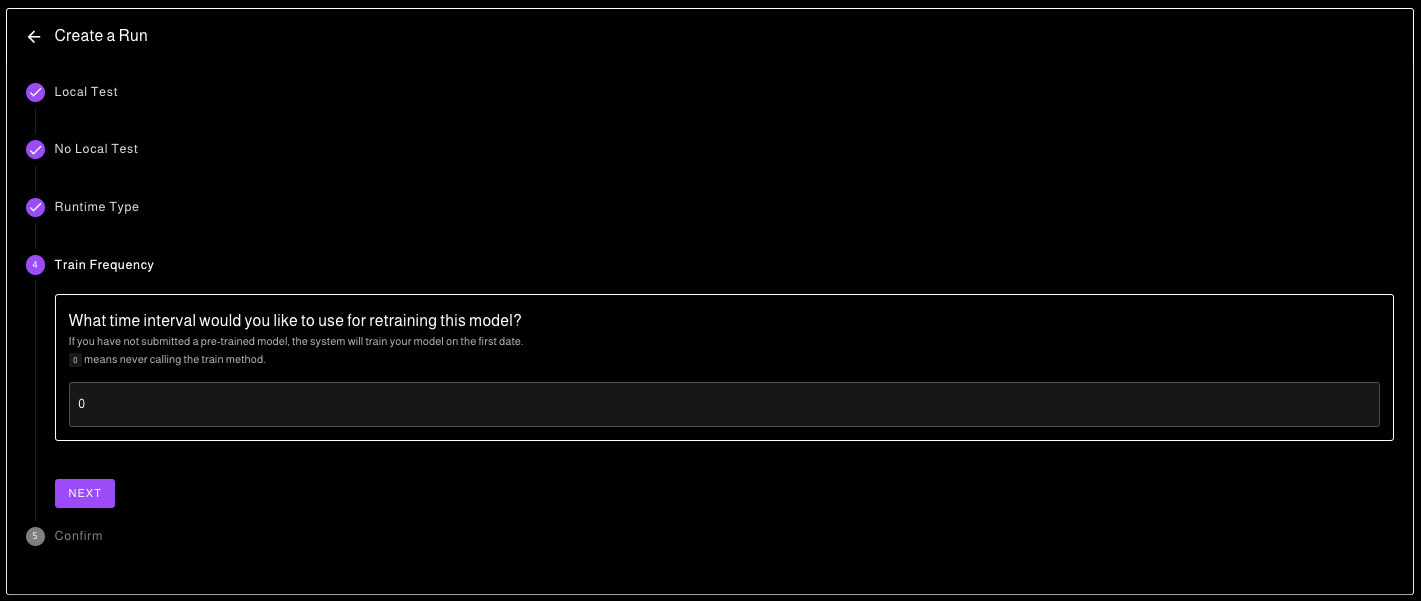
**STEP 3.**
You can configure the re-training frequency of your model as you wish.
{% hint style="info" %}
Remember that your code will need to process all the dates in the private test set in under 5 hours of compute. Adjust your retraining frequency so that your code remains within the limits.
{% endhint %}